Qattara Depression Technologies

Noah Smith has a recent post, ‘EVs are just going to win’ about how EVS are clearly a better tech than ICE vehicles and will increasingly dominate as batteries improve and prices fall. It got me thinking about how humanity goes about ‘unlocking the tech tree’, and how each iterative improvement generally has to improve on the last and be economical to lead to progress being made. This is quite a bit like evolution, in that each subsequent adaption must work on its own and build on what came before, hence seemingly illogical biological designs like the unnecessary sweeping loop of the recurrent laryngeal nerve in mammals.
It seems like the push for ‘green tech’ just so happens to have helped us break out of that path in a few different areas. Solar is going to give us the cheapest electricity ever. But we wouldn’t have got there just waiting for market forces. Solar research would have been a backwater, languishing with no investment due to its uneconomical nature. It took a massive subsidy programme to push the tech forward while still uneconomical. EVs are basically the same. Direct air capture tech, again initially funded for climate reasons, might unlock cheap, abundant hydrocarbons.
I propose a name for these kinds of technologies: ‘Qattara Depression techs’. The Qattara Depression is an area of desert in Northwestern Egypt near the Mediterranean that is below sea level. If the Mediterranean could reach it, it would fill up to become a sea itself. The sea can’t fill it up because it follows gradients and takes the path of least resistance. But if a narrow channel could be dug to the depression, a huge area would be filled, and a new sea made.
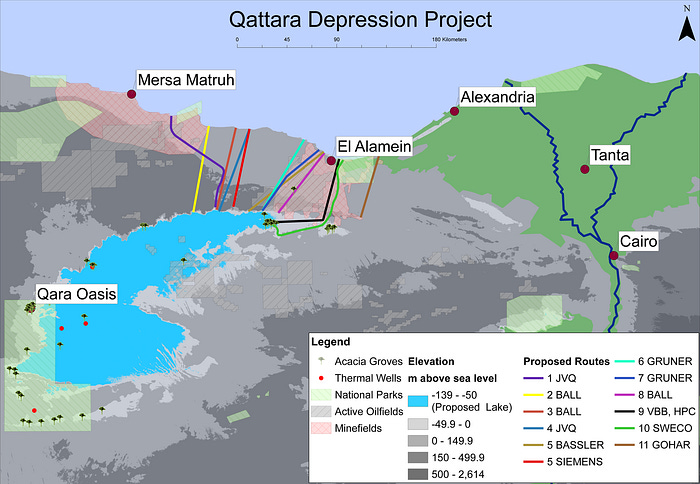
Solar and EVs are like this. It took foresight and planning to direct investment in them during their early years to ‘dig the channel’, but now the channel is dug they can flood a vast area by just responding to natural forces (economic incentives in the tech case, gravity in the water case).
It seems likely that there are far more techs like this. Solar and EVs were subsidised because they were green, not because policymakers could see that they represented a more effective technology and it was worth breaking out of this local optimum and moving towards a global optimum.
The techno-capital machine is a bit of a greedy algorithm.
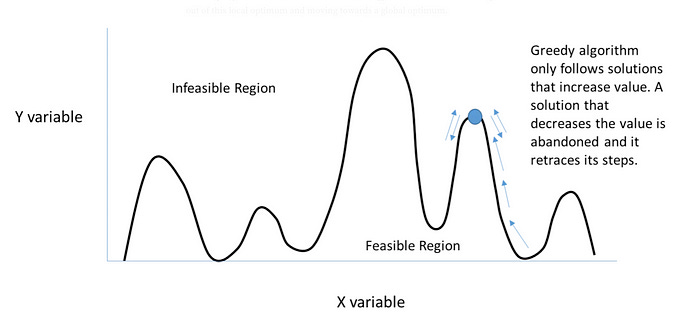
The proper term for what I’m calling ‘Qattara Depression techs’ might be something like local optima technologies Vs global optima technologies — but I think that implies we can know what a true global optimum tech is, which is unknowable. There will always be new, better techs to discover. I think of ‘Qattara Depression techs’ as discovering new, better local optima to shift to.
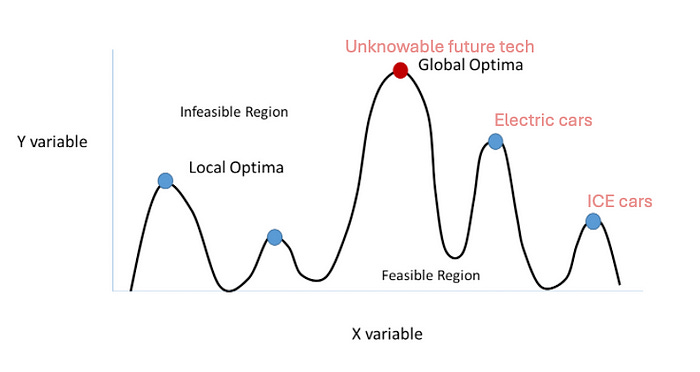
It takes huge government programmes or bold, visionary founders to dig these channels and flood new metaphorical Qattar Depressions. We’re currently in the middle of seeing one flooded by SpaceX with reusable rockets.
Reusable rockets are a far better local optima than disposable rockets, but the tech required to get closer to re-use doesn’t improve the economics of space launch until the new optima is achieved. Therefore, before SpaceX, there was no trend towards increasing reusability in space launches, and no sign that the market would soon have developed a reusable rocket a few years later than SpaceX managed to. It took the crazy vision and considerable funds of Musk to dig the channel to the new tech.
What other tech stacks are a contingent local optimum which we could break out of?
I suspect there are many. The laws of physics should be our guide. Cargo airships, geothermal tech, and antimatter rockets are all strong contenders. When identifying them, though, it’s important not to pick depressions that are too far away, requiring infeasibly large channels to be dug. These ‘Turfan Depression’ techs would be a trap.
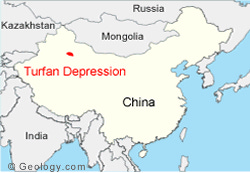
The Turfan Depression is 154 meters below sea level, but you’d be a fool to want to flood it with seawater, given the huge mountains and vast distances between it and the sea.
So there’s an obvious sweet spot we’re seeking. Large depressions (big possible impacts) close to shore (the tech required is not many decades away). The closest depressions are already flooded by venture capital, which has a well-known playbook for building short channels to them. But I think the example of green tech shows that large depressions exist, requiring longer channels than VC can provide. What kinds of organisations could be set up to build longer channels? Classic examples include Bell Labs, the Manhattan Project and the Energiewende.
All new potential technologies are not ‘Qattara Depression techs’, only ones for which there’s no obvious market route to figuring out the steps on the way to unlocking them. For example, anti-ageing tech or more advanced AI are both hugely exciting and valuable technologies, but there’s a clear route to market for marginal advances in these areas. A startup that can delay ageing by 10% has an extremely valuable product, one that will attract investment. Marginal advances can keep building on each other until longevity escape velocity is achieved. However, a start-up that can build 10% of a space tether is useless unless it can build the other 90%.
Promising parts of the tech tree not being filled in represents a sort of technological market failure, one that it could be imminently beneficial for humanity to address.
The fact that some of the most important technologies of the 21st century (the solar revolution, EVs, maybe synthetic hydrocarbons) emerged due to green subsidies inadvertently bending the greedy algorithm of techno capital away from its previous local optima should have us all asking questions of what else our system of research incentives is missing. I sense this means we could be exploring the tech tree in many more directions than we currently do, and in doing so we’d find more ‘low-hanging fruit’, because we hadn’t previously looked so hard there.
It’d be great to collate a list of such possible techs, with the justifications for why they’d be a better local optima than the current one. That idea bank could be helpful for smart, driven potential founders. I’ve already mentioned cargo airships, geothermal and reusable rockets. Antimatter rockets might be as well, but they could be so far off as to be unfeasible and, therefore, a potential ‘Turfan Depression’ tech. Other things that could potentially be incredibly useful new technologies that aren’t close to being developed because market forces only work for them once they are developed and not during their development path include:
Nuclear fusion (although this seems to attract funding from visionary founders and governments)
New charter cities (they work at scale, but need huge initial set-up)
Lab-grown meat
One or more of: X-ray lithography, electron beam lithography, focused ion beam lithography, nanoimprint lithography, and quantum lithography
What else should be added?